Auxiliary Verb (Group 1) (Basic ㊦ 76)
Something has been done to something and the resultant state of that action remains.
Equivalent: Have been done; be done
| Vてある | 話してある | Has been said |
| 食べてある | Has been eaten |
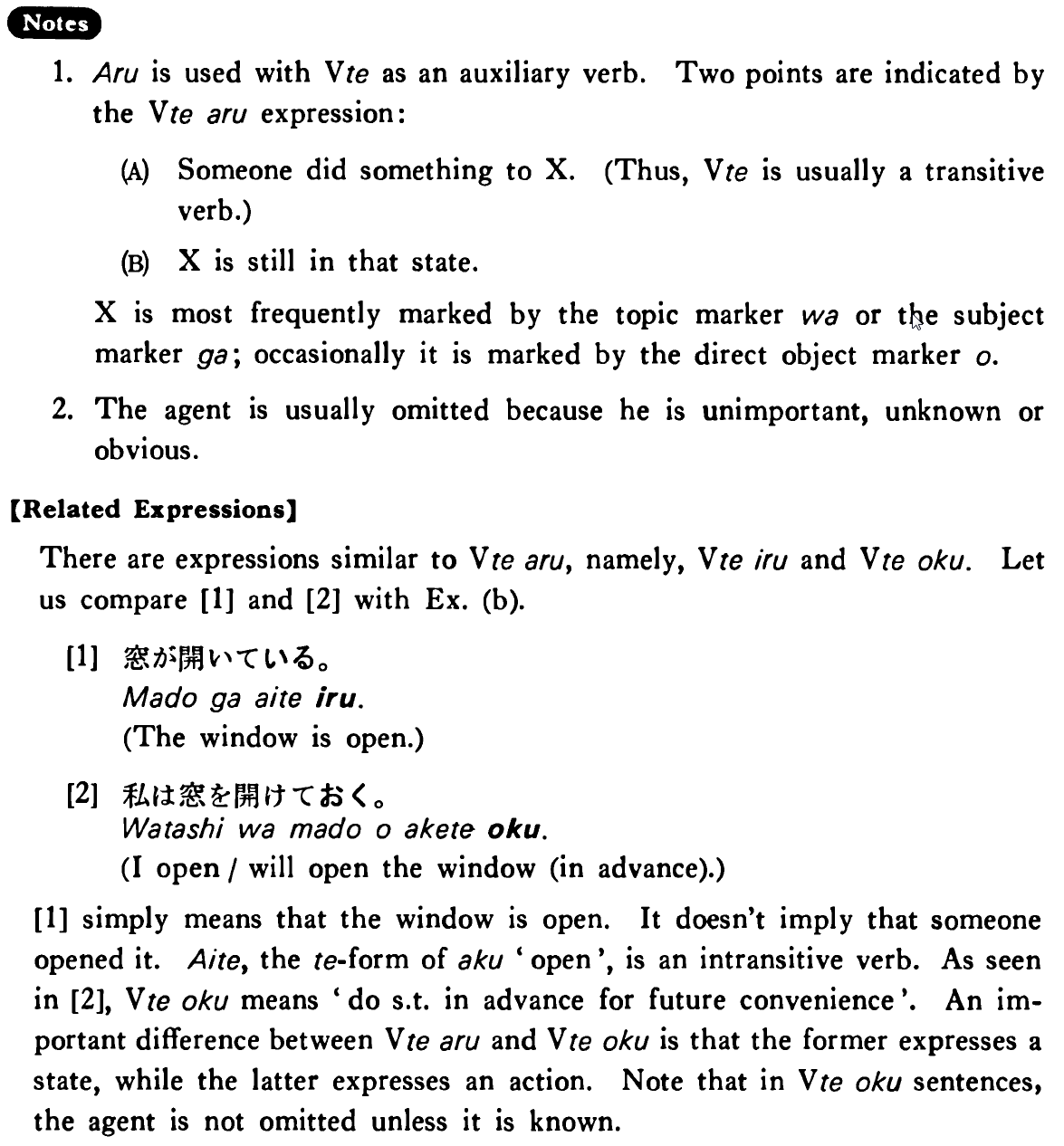
1. ある is used with Verbて as an auxiliary verb. Two points are indicated by the Verbてある expression:
X is most frequently marked by the topic marker は or the subject marker が; occasionally it is marked by the direct object marker を.
2. The agent is usually omitted because he is unimportant, unknown or obvious.
【Related Expressions】
There are expressions similar to Verbてある, namely, Verbている and Verbておく. Let us compare [1] and [2] with Example (b).
[1]
[2]
[1] simply means that the window is open. It doesn't imply that someone opened it. 開いて, the てform of 開く 'open', is an intransitive verb. As seen in [2], Verbておく means "do something in advance for future convenience'". An important difference between Verbてある and Verbておく is that the former expresses a state, while the latter expresses an action. Note that in Verbておく sentences, the agent is not omitted unless it is known.